

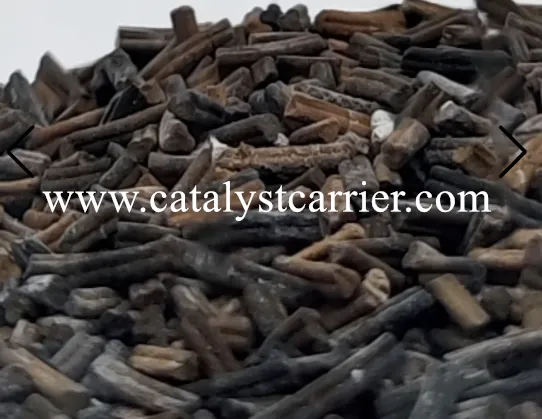
Naphtha C4 C5 C6 130-170 ℃ Low Temperature Light Hydrocarbon Isomerization Catalyst
Description
Technical Parameters
Naphtha C4 C5 C6 130-170 ℃ Low Temperature Light Hydrocarbon Isomerization Catalyst
1. C4 C5 C6 Low temperature light hydrocarbon isomerization catalyst is prepared by using precious metal Pt supported on alumina chloride carrier;
2.It has the advantages of high isomerization activity, good isomerization selectivity, low reaction temperature and long service life;
3. The C4, C5 and C6 n-paraffins can be converted into corresponding high-octane isoparaffins in a composition ratio close to the thermodynamic equilibrium.
Production Introduction
C4 / C5 / C6 low temperature light hydrocarbon isomerization catalyst at low temperature using precious metal Pt load on the chloride alumina carrier preparation, has high isomerization activity, good isomerization selectivity, low reaction temperature, long life and other advantages, can be close to the thermodynamic equilibrium composition, adding higher octane isomerization alkane.
Characteristics:
C4/C5/C6 low temperature light hydrocarbon isomerization catalyst with High Performance operation to iso-paraffins
Maximum isomerate octane at equivalent catalyst loadings, C4/C5/C6 Catalyst can process C, Cs, and C, feeds with all high benzene and C substance.
Volumetric yields usual exceed 99 lv-% High metal dispersion
Saturates benzene
Upgraded benefits for use in Penex process units Converts from normal to high hydrocarbons.
Naphtha C4 C5 C6 130-170 ℃ Low Temperature Light Hydrocarbon Isomerization Catalyst
1. What is naphtha isomerization catalyst?
Naphtha isomerization catalyst is an important petrochemical catalyst that can convert straight-chain alkanes into branched alkanes and improve the octane number of naphtha. It is usually composed of multiple elements such as platinum, molybdenum, germanium, etc., and has the characteristics of high efficiency and high selectivity.
2. Principle of naphtha isomerization catalyst
The main principle of naphtha isomerization catalyst is to convert straight-chain alkanes into branched alkanes through adsorption, dissociation, adsorption and other steps under specific reaction conditions. This process requires a certain temperature and pressure, and the presence of a catalyst.
3. Application of naphtha isomerization catalyst
Naphtha isomerization catalyst has a wide range of applications in the petrochemical industry and can be used to produce high-octane gasoline, aviation fuel and other products. At the same time, it can also increase the added value of petroleum products and improve the economic benefits of oil refining enterprises.
Physical properties & Activity Indicators:
| No. | Item. | Numeric Value. |
| 1. | Shape | Cylindrical Bar |
| 2. | Diameter, mm | Φ 1.6±0.2 |
| 3. | Crushing Strength, N/cm | 70 |
| 4. | Pt, % | 0.24 |
| 5. | Sock Loaded ABD, lb/ft | 49 |
| 6. | Dense Loaded ABD, lb/ft Metals | 54 |
Service Conditions:
| No. | Item. | Numeric Value. |
| 1. | Reaction Temperature(Initial Temperature), ℃ | 130 |
| 2. | Reaction Temperature(Late Temperature), ℃ | 170 |
| 3. | Reaction Pressure, MPa | 2.8~3.5 |
| 4. | WHSV, N/cm | 1.5~2.0 |
During the primary and secondary processing of crude oil, light hydrocarbon fractions with C5/C6 as the main components will be produced. The C4/C5/C6 light hydrocarbon fraction mainly includes light naphtha and raffinate from aromatics extraction.
Among these components, C5/C6 are mainly n-paraffins, and the overall octane number is low, and the isoparaffins with higher octane number are obtained after being processed by the isomerization unit. The octane number can be increased by 30-40 units after the isomerization of C5 alkanes, and the octane number can be increased by 50-70 units after the isomerization of C6 alkanes.
It can be seen that isomerized oil with high octane number can be obtained by isomerizing C5/C6 n-paraffins, which is one of the economical and effective preparation methods for gasoline blending components.
Hot Tags: naphtha c4 c5 c6 130-170 ℃ low temperature light hydrocarbon isomerization catalyst, China naphtha c4 c5 c6 130-170 ℃ low temperature light hydrocarbon isomerization catalyst manufacturers, suppliers, factory, Alumina Catalyst Carrier, Shift Catalyst, Sphere Shape Alumina Catalyst Support, Clover Catalyst Carrier, Gamma Alumina Catalyst, Spherical Alumina Carrier
Send Inquiry
You Might Also Like


